


When the Dubai Metro opened in 2009, it permanently redrew the city's property map. Buildings a short walk from a station pulled ahead of their neighbours in the years that followed, and districts that had been little more than places to sleep gradually grew into complete communities. Dubai is now repeating that story in the east of the city. The Dubai Metro Blue Line will connect Mirdif, Dubai Creek Harbour, International City, Dubai Silicon Oasis and Academic City to each other and to the heart of Dubai. And the market has not waited for opening day: since the line was announced, rents across most of these areas have risen several times faster than the Dubai average. In this article we look at what the metro changes in each district, and what the communities along its route are likely to look like in a few years' time.
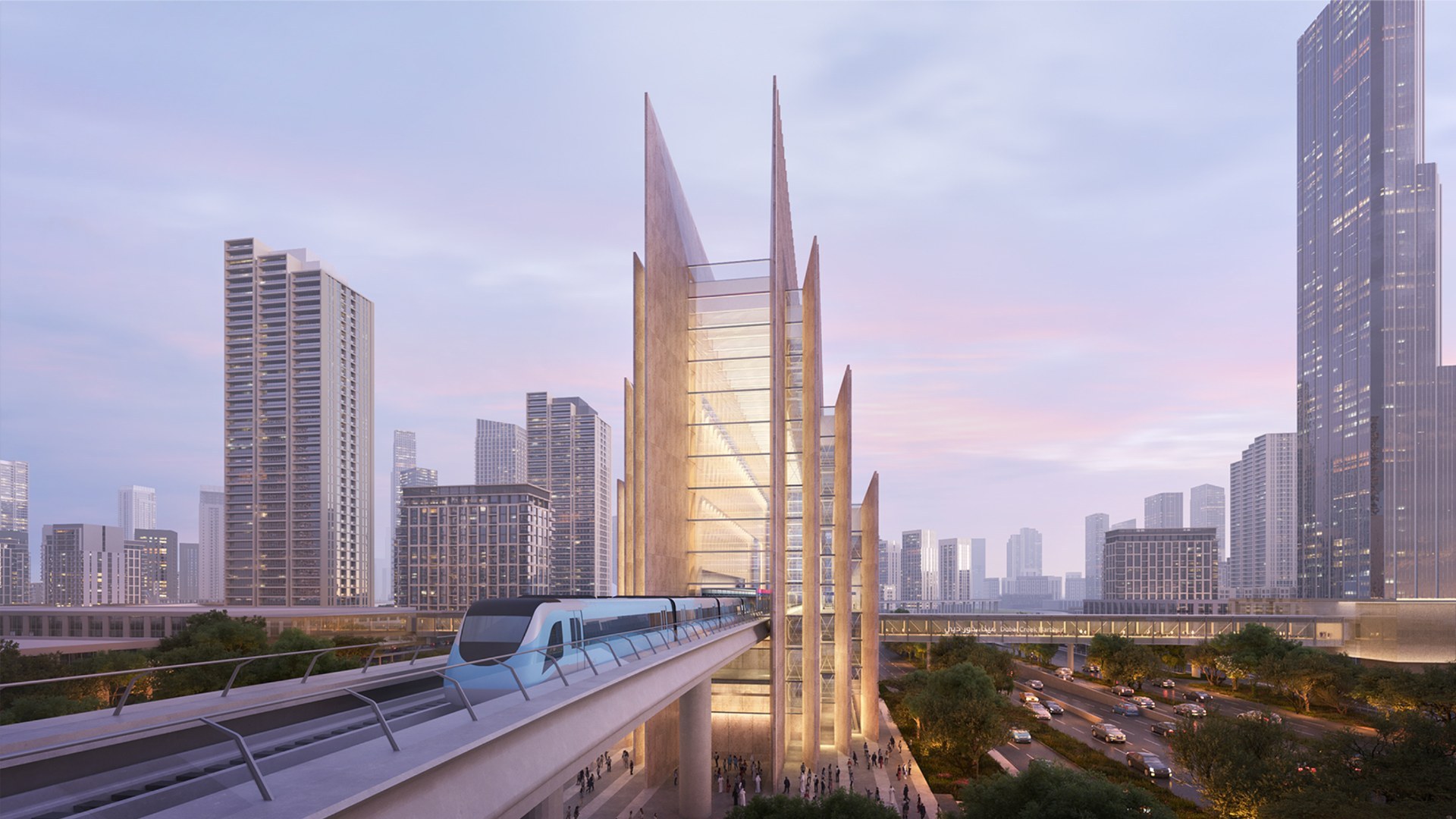
- The Blue Line runs for 30 km with 14 stations and is scheduled to open on 9 September 2029, the 20th anniversary of the Dubai Metro.
- It takes the metro across Dubai Creek for the first time and links up with the Green Line (Creek Station) and the Red Line (Centrepoint Station).
- At Dubai Creek Harbour, the 74-metre Emaar Properties Station will be the tallest metro station in the world, right next to the giant Dubai Square mall.
- Dubai Square will need a large workforce, and much of it lives in International City and Dubai Silicon Oasis; the metro will put both districts just a few stops from work.
- Between the announcement in November 2023 and mid-2025, rents along the route rose by an average of 23%, and by as much as 43% in Academic City.
The route: two branches and three interchange stations
The Blue Line is made up of two routes. Route 1, 21 km long with 10 stations, starts at Creek Station in Al Jaddaf on the Green Line, crosses Dubai Creek on a 1.3 km viaduct and runs through Dubai Festival City, Dubai Creek Harbour and Ras Al Khor to International City 1. From there it continues to International City 2 and 3, Dubai Silicon Oasis and finally Academic City. Route 2, 9 km long with 4 stations, starts at Centrepoint Station in Al Rashidiya on the Red Line and runs through Mirdif and Al Warqa to International City 1.
That creates three interchange stations: Creek, Centrepoint and International City 1. Roughly half of the line runs underground and the rest is elevated. Dubai's Roads and Transport Authority (RTA) expects the line to carry around 200,000 passengers a day by 2030 and around 320,000 by 2040, cut traffic on the roads it serves by about 20%, and bring residents of these districts within about 20 minutes of Dubai International Airport. Construction officially began in June 2025, and by November that year the RTA reported 10% progress.
Dubai Creek Harbour: the world's tallest metro station and a new commercial heart for eastern Dubai
Dubai Creek Harbour is Emaar Properties' landmark waterfront project on Dubai Creek: more than 11 million square metres, around three times the size of Downtown Dubai, with a total development cost of AED 180 billion. About 40,000 people already live there, and Emaar puts its eventual capacity at around 200,000 residents.
The symbol of the metro's arrival is the Emaar Properties Station: a 74-metre structure designed by SOM that will be the tallest metro station in the world, able to handle up to 160,000 passengers a day. Emaar has bought the naming rights for ten years from opening, a clear sign that the developer itself sees the metro as part of Creek Harbour's future value. Ground was broken on this station in June 2025 as the first station of the Blue Line.
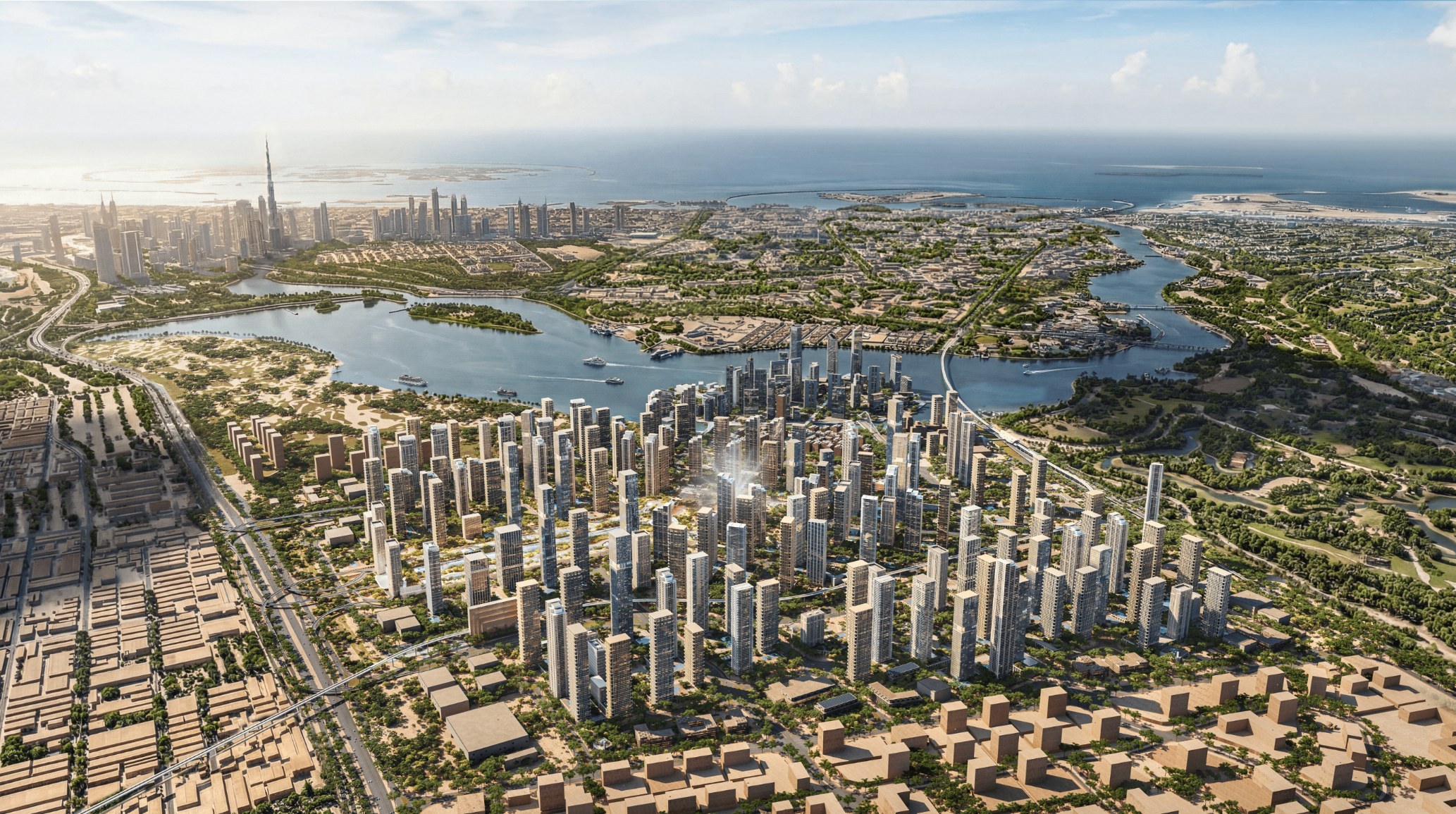
Next to the station, Emaar unveiled the final design of Dubai Square in December 2025: a retail and leisure destination with 2.6 million square metres of retail, hospitality and commercial space, billed by Emaar as the world's first drive-through mall, with streets that cars can drive along between the shops. Construction is under way, and opening is expected around three years after the unveiling, almost exactly when the Blue Line opens.
In November 2026 Emaar announced the next step: the Dubai Square Business District, 300,000 square metres of office and commercial space worth AED 12 billion, wrapped around the mall. Two metro stations will serve the district directly, with office buildings linked to them by climate-controlled walkways. Four hotels will be built around Dubai Square, and according to the masterplan more than 75,000 homes will surround Creek Harbour.
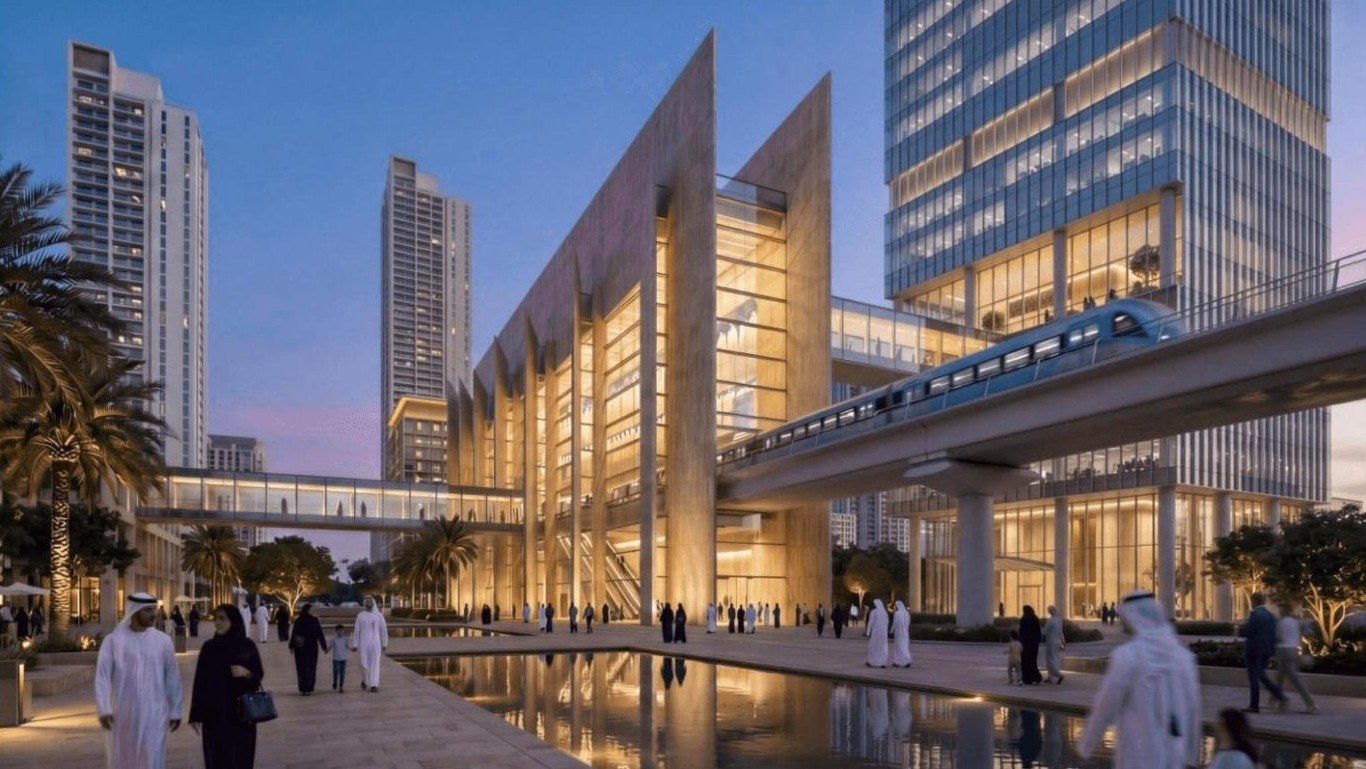
Dubai Square and the workforce that has to get there every day
A mall on this scale, together with 300,000 square metres of offices and several hotels, is not just a shopping centre; it is a major employer. Retail staff, restaurant and café teams, security and cleaning crews, hotel and warehouse staff, technical teams and office workers will add thousands of new jobs at Creek Harbour. Emaar itself has stressed that employees will be able to live anywhere in Dubai and get to work without driving. But much of this workforce will not live in Creek Harbour itself. The natural choice for them is the nearby, more affordable districts that sit right on the same line: International City, Dubai Silicon Oasis and Ras Al Khor.
This is where the Blue Line changes the equation. Today, getting from International City to Creek Harbour means a taxi, a crowded bus or a car stuck in rush-hour traffic. From 2029, the same trip will be just a few metro stops. The result works for both sides: employees can comfortably live close to work at a reasonable cost, and employers at Creek Harbour gain access to a large pool of staff. Dubai has seen this pattern before: when the Red Line connected Downtown and The Dubai Mall to residential districts, rental demand in buildings near the stations rose and stayed high.
For investors, this means rental demand tied to a real economic engine rather than to an area's passing popularity. Small and mid-sized units in International City and Dubai Silicon Oasis within walking distance of a station stand to benefit most directly, and they are ideally suited to long-term lets to people working at this new hub.
International City and Dragon Mart: from the edge of the map to the heart of the network
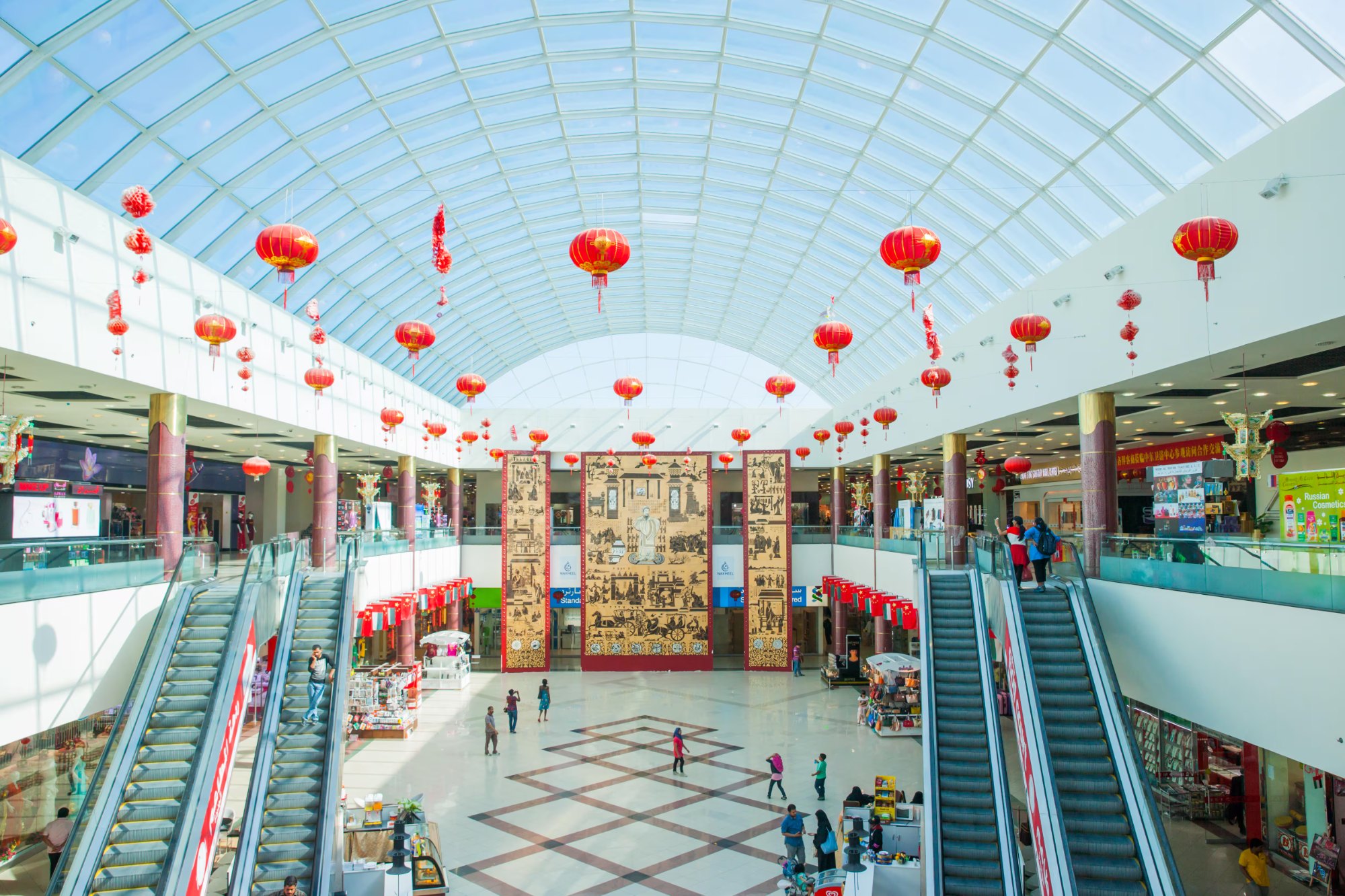
For years, International City had one image: Dubai's most affordable apartments, next to Dragon Mart, the well-known trading hub for Chinese goods, but far from the metro. The Blue Line changes that completely. International City 1 is set to become the largest underground interchange station on the entire Dubai Metro network, the point where the two branches of the Blue Line meet. One train will take residents to Creek Harbour and Al Jaddaf, another to Mirdif and the Red Line.
That also changes the profile of the community. Until now, most residents chose the area mainly on price. With the metro, International City becomes attractive to a new group too: young professionals, couples and specialists who work in Downtown, at the airport or at Creek Harbour and want sensible rents with fast access. Nakheel is also reshaping this part of the city with projects such as Warsan Village and Dragon City Towers. As new residents arrive, shops and services improve, and a cycle begins that turns the area from a low-cost dormitory into a complete urban community.
Dubai Silicon Oasis and Academic City: a knowledge district on the metro
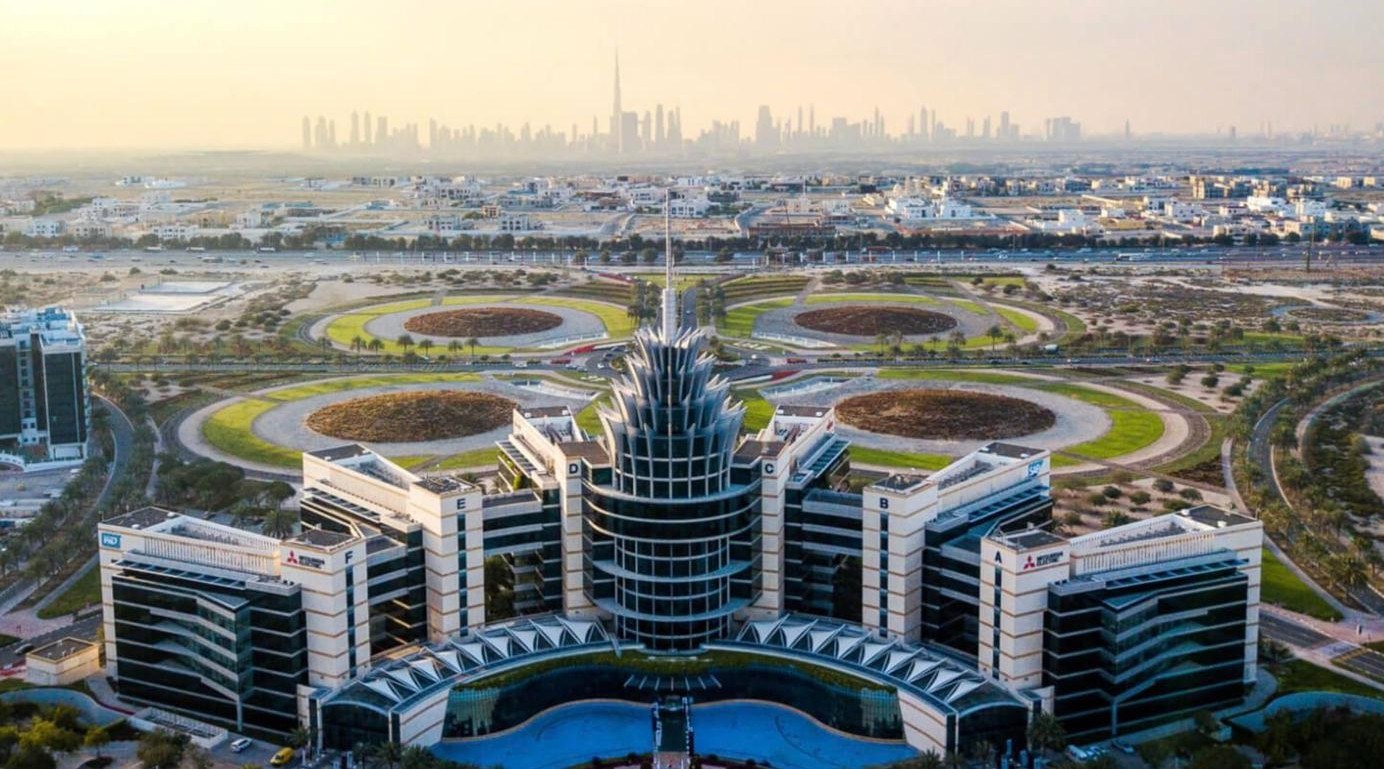
Dubai Silicon Oasis is Dubai's technology free zone and home to around 77,000 residents. Its mix of tech company offices, universities, schools and a large mall has made it one of the city's most complete middle-income communities. Its only real gap was the lack of a rail link to the city centre, and the Blue Line fills it.
Academic City is the last stop on Route 1: a university district home to institutions such as Heriot-Watt and Middlesex, expected to have more than 50,000 students by 2029. The journey from Academic City to Creek Station will take about 25 minutes and to Centrepoint about 17 minutes, with no change of train. For an area that until now has been reachable almost only by car, that is a complete transformation, and it explains why Academic City has recorded the strongest rental growth anywhere on the route.
Mirdif and Al Warqa: family communities with a direct link to the Red Line
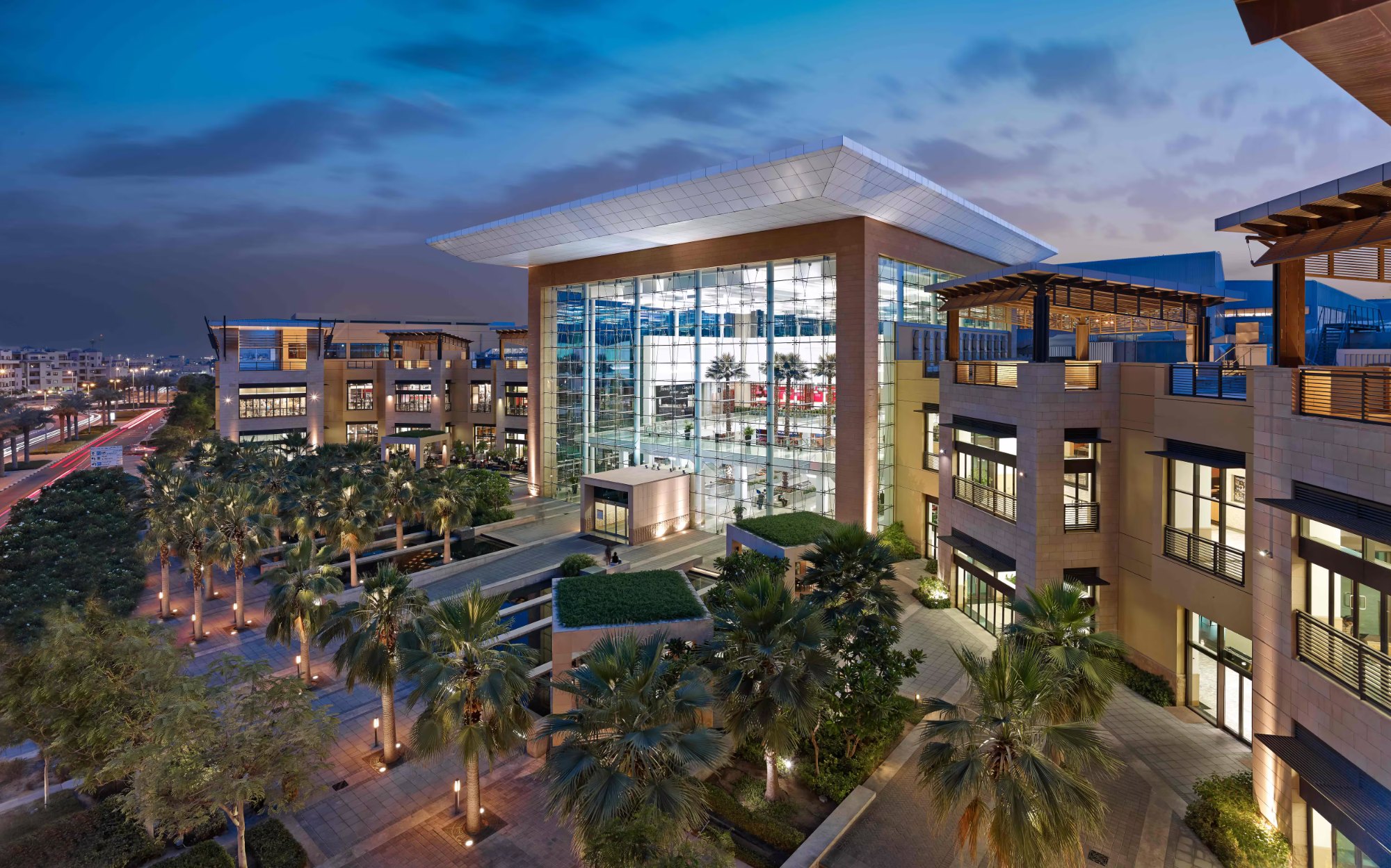
Mirdif is one of Dubai's most established villa and family neighbourhoods: close to the airport, with well-regarded schools, Mushrif Park and City Centre Mirdif. The Blue Line's second branch connects Mirdif and Al Warqa to Centrepoint Station on the Red Line in one direction and to International City and Dubai Silicon Oasis in the other. For families who live in Mirdif and work in Downtown, Deira or at the airport, that means a new and reliable alternative to traffic on the eastern roads. In an area whose value rests largely on family quality of life, better access usually translates into steady demand and values that hold up over the long term.
How the market has reacted so far
The market did not wait for the opening. According to market data, between November 2023, when the Blue Line was announced, and mid-2025, rents in the areas along the route rose by an average of 23%. The biggest jump was in Academic City, where annual studio rents went from AED 42,000 to AED 60,000, an increase of 43%. Dubai Creek Harbour followed with 30%, Dubai Silicon Oasis and Al Warqa with 28%, International City with 22% and Mirdif with 15%.
Sale prices have followed a similar path. Data shows the average price per square foot for resale apartments in Dubai Creek Harbour rose from around AED 1,880 in the first half of 2023 to around AED 2,400 in the first half of 2026, an increase of close to 27% in three years. In Dubai Silicon Oasis, apartment prices rose by around 80% between the end of 2022 and 2024. Growth in Creek Harbour has eased compared with the 2024 surge and stood at around 5% over the past 12 months, but this is a pause before the metro and Dubai Square open, not after.
The Red Line lesson: most of the value is created after opening
Dubai's own experience is a useful guide. Market studies show that after the Red Line opened in 2009, properties within a 5 to 10-minute walk of a station gained around 40% in value, and those within 15 minutes more than 25%. Other estimates show that properties near Red and Green Line stations gained more than 50% between 2010 and 2018.
The key point is that much of this growth came not on the day of the announcement but in the years after opening, as districts genuinely changed, more services arrived and new residents settled in. Market experts expect areas connected to the Blue Line to outperform areas without a metro by 25 to 30%. That is why anyone buying along the Blue Line today is still getting in before the most important phase of the transformation.
What the communities along the route will look like by 2029
Put all these pieces together and the picture of eastern Dubai at the end of this decade becomes much clearer:
- Dubai Creek Harbour grows from a waterfront residential project into a complete city centre, with the world's tallest metro station, Dubai Square and tens of thousands of new residents and workers.
- International City moves from an area chosen mainly on price to a key network hub and home to a large share of the eastern city's workforce.
- Dubai Silicon Oasis and Academic City become Dubai's knowledge and technology corridor, linking students, tech employees and young families to the whole city by metro.
- Mirdif and Al Warqa strengthen their position as family communities, this time with a direct rail connection.
The Dubai 2040 Urban Master Plan is built on exactly this model: more people living close to public transport, in districts where residents can live and work without depending entirely on a car.
 Call us
 Privacy Policy